What Actually Moves Industrial Property Prices in Klang Valley (2026)
Ask ten agents what sets the price of a Klang Valley factory and you'll get ten opinions — “location,” “the market's hot,” “near the port.” Useful, but vague.
Between us, we work both sides of this market: Jay Kew brokers industrial property across the Klang Valley, and Jasper Wu builds the machine-learning models that value it. So instead of guessing, we went to the data. We analysed 23,808 real commercial and industrial transactions across Kuala Lumpur and Selangor from April 2021 to September 2025, and built a valuation model that prices a property to within roughly 12% of its actual transacted price. Then we asked the model one question: of everything we know about a property, what actually moves the number — and by how many ringgit?
This is the answer, ranked. Transacted prices, not asking prices. No hand-waving.
Every figure below comes from transacted deals and a model measured on properties it had never seen. Where we're reporting what the data shows, it's solid. Where we stray into what might happen next, we'll say so.
How to read this
First, the boring part: yes, bigger costs more
Strip every Klang Valley industrial deal into five families of factors and weigh how much each moves the total price across all 23,808 deals:
| Force | Share of total price | What's in it |
|---|---|---|
| Size | ~53% | Land area, built-up floor area, plot efficiency |
| Location | ~23% | Distance to KL city centre, transit, port, airport, industrial zones |
| Property attributes | ~12% | Freehold vs leasehold, floor level, number of storeys |
| Market context | ~10% | The mukim's prevailing price level and recent momentum |
| Timing | ~2% | Transaction year and the interest-rate era |
About three-quarters of the headline price is just size — land area plus built-up floor area. That's true, and it's almost useless, because you already knew the bigger factory costs more. A RM9.5m detached factory isn't “9× better” than a RM1.1m terraced unit; it's mostly just bigger.
So throw size away and measure what a square foot actually costs. Price per square foot is the only honest way to compare two industrial properties — and it's where the real story lives.
What a square foot actually costs
Across the Valley, built-up industrial trades anywhere from ~RM86 to ~RM950 per square foot — an 11× spread, even though every one of these deals is “industrial.” Three things explain most of that range: subtype, location, and tenure.
Subtype: the semi-detached surprise
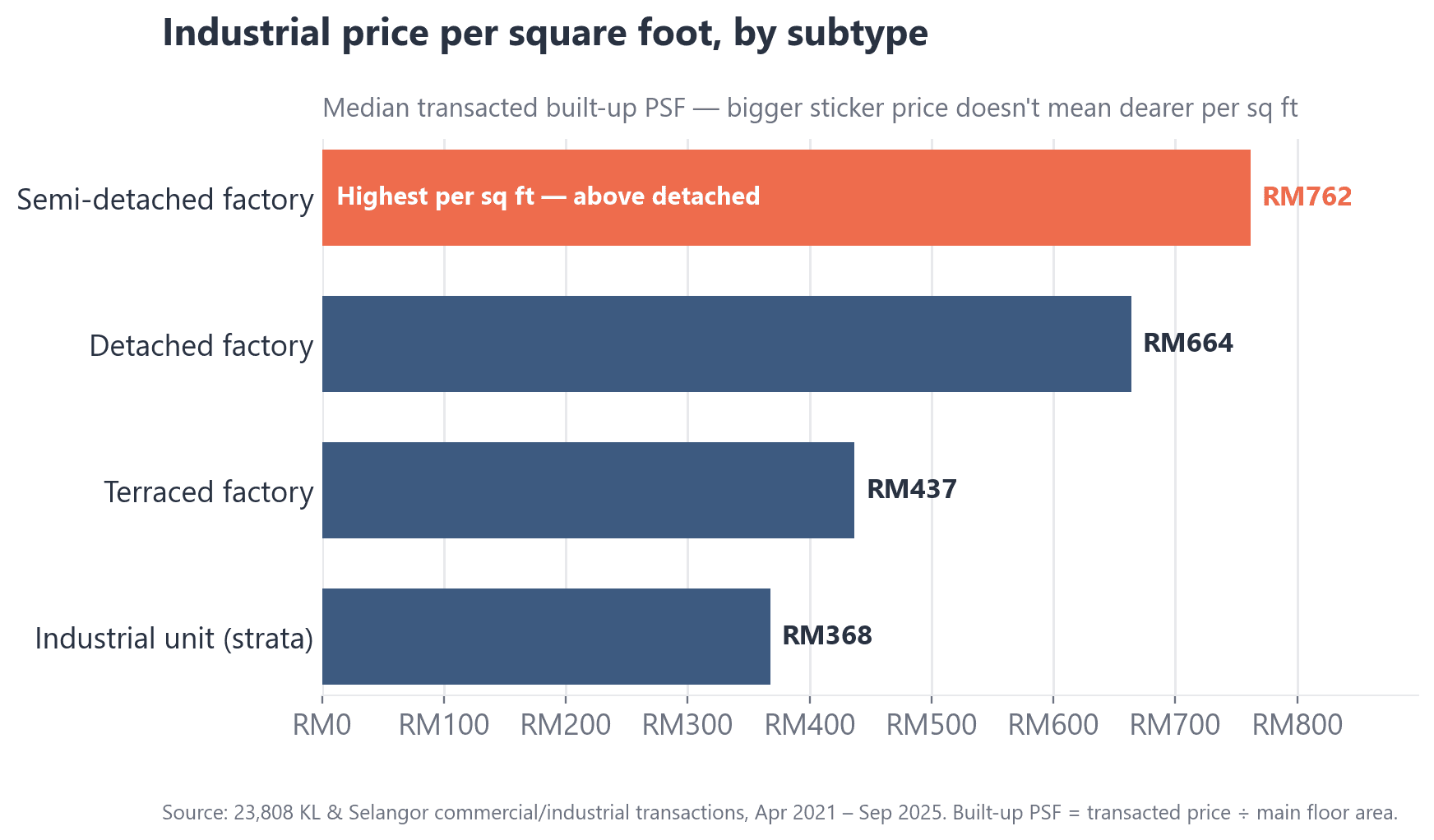
| Subtype | Median price | Median PSF (built-up) |
|---|---|---|
| Semi-detached factory | RM4.2m | ~RM762 |
| Detached factory | RM9.5m | ~RM664 |
| Terraced factory | RM1.1m | ~RM437 |
| Industrial unit (strata) | RM635k | ~RM368 |
The counter-intuitive part: semi-detached commands the highest price per square foot — more than detached. Detached factories carry the biggest sticker price, but so much of it is land that, per square foot, they come in cheaper than the semi-d sweet spot. Compare on headline price and you'd rank these exactly backwards.
Location: an 11× range — and the port isn't on top
By district, Gombak (~RM668), Kuala Lumpur (~RM659) and Sepang (~RM629) lead on PSF; Klang sits near the bottom (~RM457), above only the far exurbs. At mukim level the gap is starker still: Bandar Glenmarie tops the Valley at ~RM948/sqft, while Serendah, 60km north, trades at ~RM86 — the full 11× spread, all of it “industrial.”
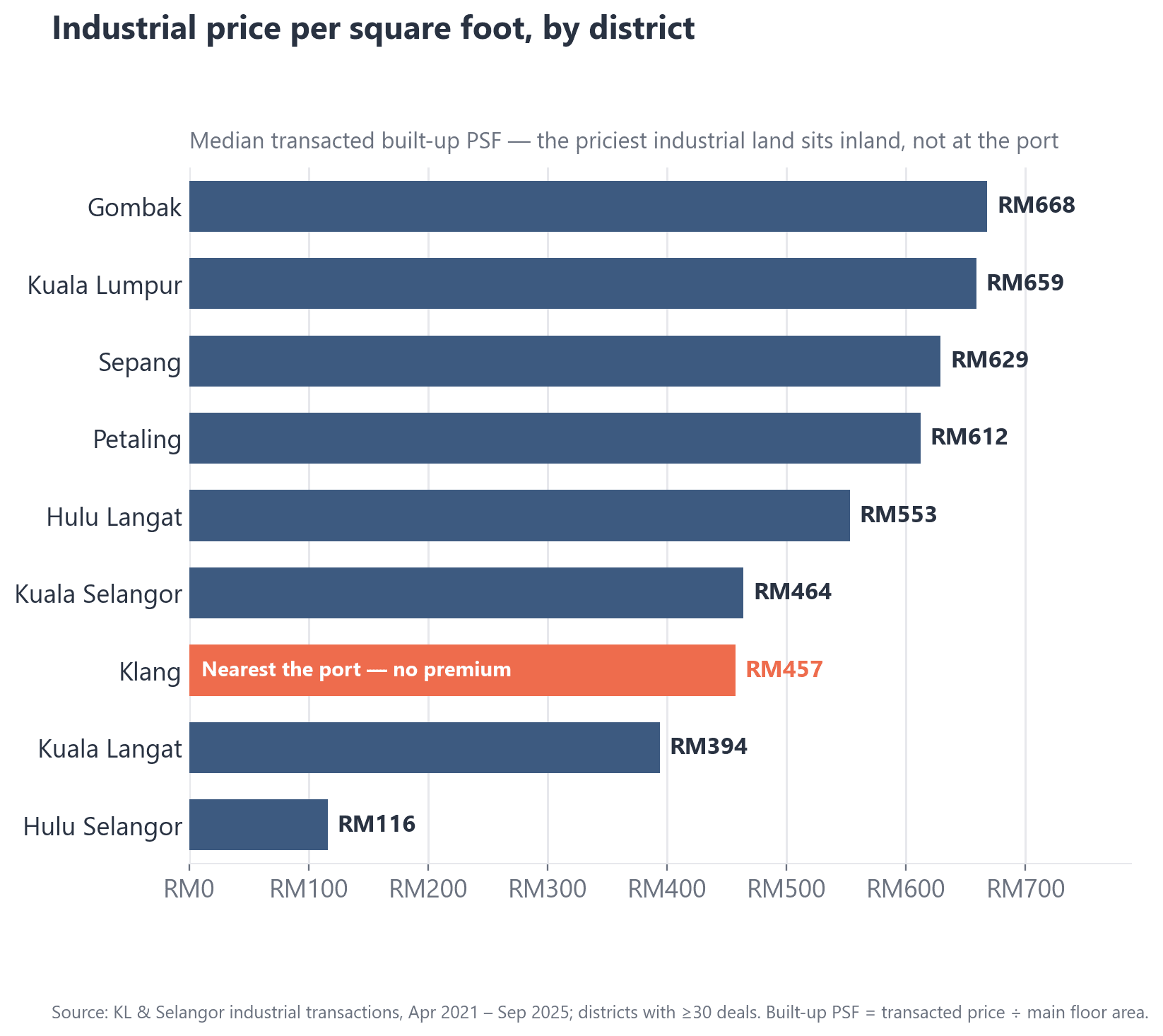
And the surprise every agent gets wrong: closeness to Port Klang does not command a capital premium. Per square foot, port-adjacent Klang is among the cheapest industrial land in the Valley; the priciest sits inland around Glenmarie, Petaling and Gombak. Distance to the KL city centre moves value about twice as much as distance to the port. The port drives logistics rents and demand — not capital value per square foot.
Tenure: freehold's quiet premium
Freehold adds roughly RM52,000 to a typical deal versus a comparable leasehold property — the largest of the non-size, non-location levers, and one that's easy to leave on the table in a negotiation.
So is it the location or the building?
The eternal client question. On total price, size and location together are about three-quarters of everything — but that's mostly the size you can already see. Compare like-for-like on PSF, with size stripped out, and location does the heavy lifting: a well-built factory in Serendah (~RM86/sqft) will never reach Glenmarie money (~RM948/sqft), however good the building. Get the footprint-to-land fit right first, so you're not paying for land you can't use — then buy the best location your budget reaches.
What this means for buyers and sellers in 2026
The data above explains how prices are built from four years of completed deals. The next part is market outlook — forecasts from industry sources, not from our transaction dataset (treat them as informed expectation, not measured fact):
- Supply is rising, but demand is absorbing it. Around 12 million sq ft of new warehouse space is reported entering over the next two years (Shah Alam, Grand Valley, Rawang), yet Grade-A warehouse vacancy actually tightened from 3.9% to 2.0% through 2025 — pulled down by e-commerce, third-party logistics, data centres and advanced manufacturing.
- Rents are forecast to grow 3–5% a year in the Shah Alam and Klang/Port Klang corridors, on the back of land scarcity.
- Where it's heating up (this is from our data): on a like-for-like basis, the strongest recent momentum is in Hulu Selangor (+42% YoY), Sepang (+34%) and Petaling (+26%), with Kapar a standout high-volume mover.
You may see reports that the median industrial price fell over 2021–2025. That's a composition mirage — more affordable terraced units and strata lots transacting in later years drag the median down even as per-square-foot values held roughly flat (the headline median fell ~48%; PSF barely moved). Always read PSF, not the headline median.
A warning on “average prices”
Buying? Lead with PSF and plot efficiency, not sticker price — browse current listings →. Selling? Your land area and freehold status are doing more for your value than you think — price them in.
Bring us the address, and we'll show you where it sits against these 23,808 deals — not a guess, a measured comparison. Talk to Jay Kew →
Want your own number?
How I know this
These figures come from 23,808 transacted commercial and industrial deals across KL and Selangor (Apr 2021–Sep 2025), sourced from NAPIC's Open Transaction Data — the official transaction registry published by Malaysia's Valuation and Property Services Department (JPPH) — actual prices recorded at transaction, not asking prices. We engineered location, size, tenure and market features for each property and trained a gradient-boosted model that values held-out deals to a median error of about 12%. The “value swings” above are the model's measured contribution of each factor, expressed in ringgit at a median property value.
Limitations, stated plainly:
- It's built-up factory/warehouse and commercial transactions — not raw vacant-land sales.
- Small subtypes (e.g. standalone industrial units, n≈82) are thin and noisier.
- The model explains historical pricing well; the 2026 outlook section is expectation, not measurement.
Industrial property type benchmarks (median transacted price): industrial RM1.79m · shophouse RM1.45m · retail RM680k · commercial strata RM460k.
About the authors
Jay Kew is an industrial property agent in the Klang Valley. He brokers factory, warehouse and industrial-land deals across KL and Selangor, and brings the on-the-ground deal experience behind this series.
Jasper Wu (Wu Yang Hui) is a data scientist. He builds the machine-learning valuation models behind this series, trained on transacted-price data across KL and Selangor. Connect: LinkedIn.
Disclosure: Jay is a practising agent with a commercial interest in this market. Everything here is derived from transacted-price analysis and a documented method — not from listings or sentiment — precisely so you can check the reasoning rather than take our word for it.
Frequently asked questions
What is the average price per square foot of industrial property in Klang Valley?
It depends heavily on subtype and district. Median PSF runs from roughly RM437 for terraced factories up to RM762 for semi-detached — with detached around RM664 (lower than semi-d, because so much of a detached price is land) and strata industrial units near RM368. By district, Gombak and Kuala Lumpur lead (~RM660–670 PSF), while Klang sits lower (~RM457).
What factors most affect factory and warehouse prices in KL and Selangor?
Size first — land and built-up area drive about 53% of price. Location is next (~23%), led by proximity to the KL city centre. Tenure, floor level, local market level and timing make up the rest.
Does being near Port Klang increase industrial property value?
For rental demand, yes. For capital value, not directly — distance to the KL city centre matters about twice as much, and per square foot, port-adjacent land in Klang is among the cheapest in the Valley.
Is freehold industrial property worth more than leasehold?
Yes. Freehold adds roughly RM52,000 to a typical Klang Valley industrial deal versus a comparable leasehold property — the 7th-largest price factor in this analysis.
Which Klang Valley areas have the most expensive industrial property?
By price per square foot: Bandar Glenmarie (~RM948), Batu (~RM846) and Bandar Sunway (~RM810) lead; at district level, Gombak, Kuala Lumpur and Sepang are dearest.
Are Klang Valley industrial prices rising in 2026?
Per square foot, values have held firm — not the ~48% “fall” the headline median implies — supported by Grade-A vacancy near 2% and 3–5% forecast rental growth. Expect stability-to-modest-growth, and read PSF, not the headline median.